2026-11-19
Will Square Jaw Surgery Cause Sagging? Key Points for a Defined Jawline
Square jaw surgery doesn't always cause sagging. This article explains the real causes of post-surgery sag and why preserving a defined jawline matters more than removing bone.
Hello. This is Dr. Hyun-woo Cho of Dimensional Plastic Surgery.
When I consult patients about square jaw surgery, one of the questions I hear most often is, “Doctor, if I have square jaw surgery, won't my face sag later on?”
If you search online, it's not hard to find stories of sagging after square jaw surgery.
Some explanations say that when a lot of bone is removed, the skin and soft tissue are left behind and droop downward.
Many people hear these stories and hesitate to go through with the surgery.
But does square jaw surgery really cause sagging?
Today, I'll explain why sagging occurs after square jaw surgery, along with the changes in the jawline that I consider more important when planning the procedure myself.
Does square jaw surgery really make your skin sag?
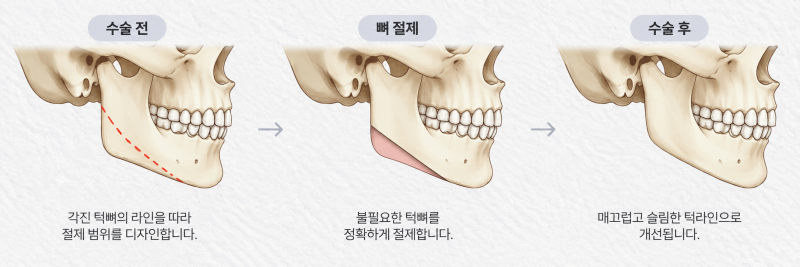
First, square jaw surgery is a procedure that reshapes the bone centered on the mandibular angle, the back corner of the lower jaw, to reduce the width of the lower face and soften its angular look.
Sagging, however, is mainly a phenomenon in which soft tissues such as skin and fat shift downward or lose elasticity.
As we age, skin elasticity declines, the position and volume of facial fat change, and the structure of the retaining ligaments and muscles can also change.
So, does reducing the jawbone necessarily cause the soft tissue to move downward?
Assuming that the fleshy part under the jaw will simply drop due to gravity just because the angular part of the lower jaw was reduced is an oversimplification.
Of course, the soft tissue of the face can change after surgery.
This is because results can vary depending on the extent and method of surgery, skin elasticity, and the amount of fat and muscle.
In fact, a study published in 2022 analyzed the three-dimensional changes in muscles before and after surgery in 29 patients who had square jaw surgery.
The study found that, after surgery, the volume of the masseter muscle decreased by an average of 18.4%.
This study shows that muscle and soft tissue can change after square jaw surgery.
However, a decrease in masseter volume does not necessarily mean the face sags, because this study did not directly prove sagging.
Therefore, when discussing sagging after square jaw surgery, we need to distinguish whether the skin and fat actually moved downward, whether muscle volume decreased, or whether the jawbone's shape changed and the facial contour simply looks different.
These three are different phenomena.
The jawline matters more than sagging
When I think about square jaw surgery, I believe there's a part that deserves just as much attention as worries about sagging.
That is how the jawline looks after surgery.
The goal of square jaw surgery is to reduce the width of the lower face and soften an angular jaw. But there's one point worth considering here.
Making the face look smaller and making the jawline look defined are not necessarily the same thing.
Simply put, the jawbone serves as the basic framework of the jawline we see.
So what happens if too much of this part is removed?
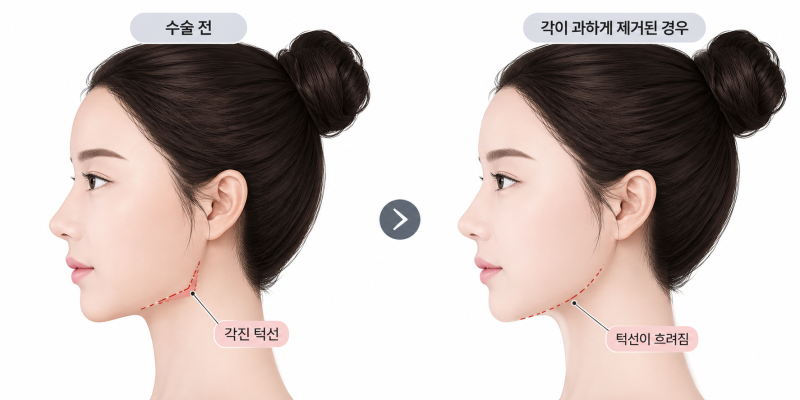
The width of the face may decrease, but the angle of the jaw and the original facial contour may also weaken.
As a result, the face may look slimmer, but the jawline may appear blurry instead.
Especially for patients whose jawbone already has sufficient three-dimensional definition, removing a large amount of bone does not necessarily lead to good results.
I think this is a very important point in square jaw surgery.
Most patients are interested in how much smaller their face will become. But once the bone is reduced, we should also think carefully about what kind of jawline will remain.
Is it a good surgery to reduce the mandibular angle as much as possible?
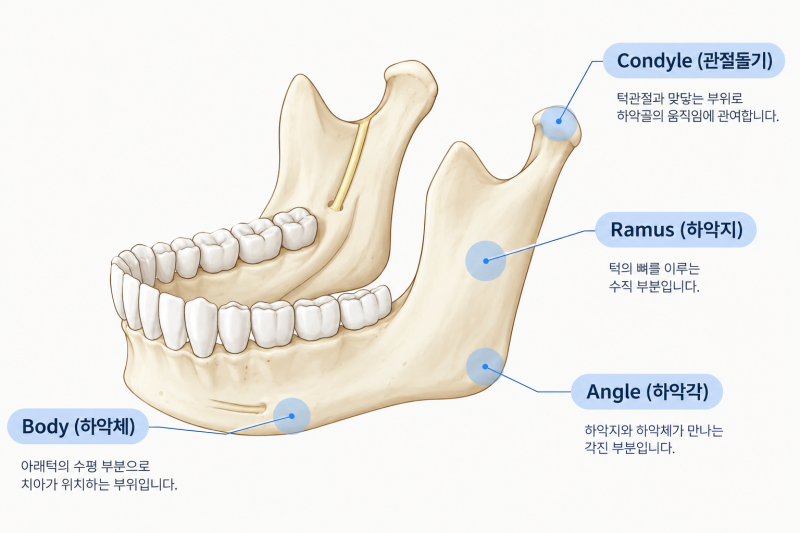
The mandibular angle is where the vertical part of the lower jaw, the ramus, meets the horizontal part, the body of the mandible.
The shape of this angle affects not only the facial width seen from the front but also the jawline seen from the side.
Long resection of the mandibular angle has been widely used to reduce an angular jaw. However, if you focus only on eliminating the angular part, you may lose the natural shape of the jaw.
In a study published in 2024, researchers compared different square jaw surgery methods in 106 patients.
The study reported that not only how much the mandibular angle is reduced, but also how its physiological shape is preserved after surgery, can affect soft tissue changes and overall appearance.
A retrospective study of 104 patients published in 2025 also reported that when a surgical technique preserving the shape of the ramus was applied, no significant laxity of the lower facial soft tissue was observed during short-term follow-up.
Of course, these research results cannot be applied directly to every patient, because surgical methods, bone structure, and follow-up periods all differ.
But what is clear is that making the jaw look slimmer does not mean removing the mandibular angle as much as possible.
When I perform square jaw surgery, I believe it's more important to leave an appropriate mandibular angle that suits the patient's facial shape and create a natural curve that flows from the chin tip to the area below the ear, rather than focusing on how much bone was removed.
Why a thick neck makes the jawline look blurry
The jawline isn't determined by the lower jawbone alone. The jawline we perceive as defined appears when the boundary between the chin and neck is clearly distinguished.
But what about when the neck is thick or there's a lot of fat under the chin?
When the boundary between the lower jaw and neck is unclear, the jawline can look short and dull.
Even if the jawbone itself is slim, a large volume in the neck can blend the face and neck together so naturally that the jawline doesn't stand out.
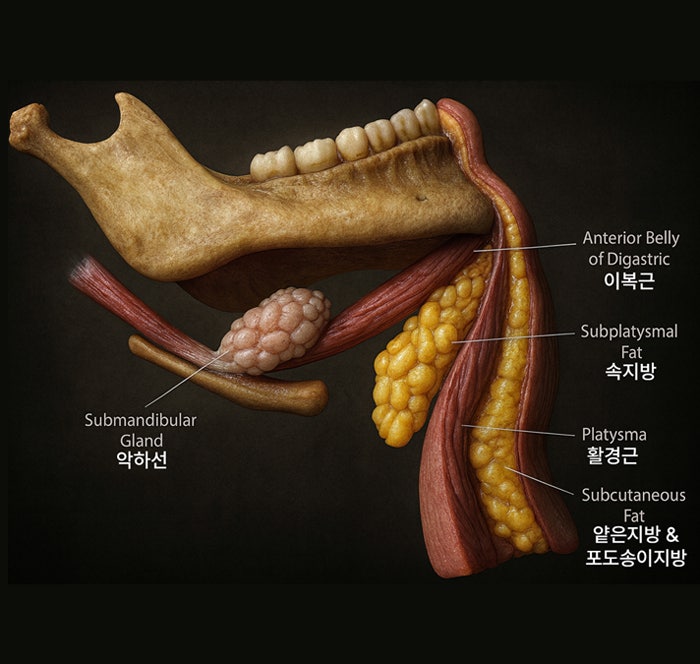
Several structures are involved here.
The subcutaneous fat under the chin, the deeper fat layers, the position and size of the platysma, digastric muscle, and submandibular gland, as well as skin elasticity, all influence how the boundary between the jaw and neck is formed.
Put simply, no matter how slim you make the jawbone, if there's a large volume in the neck below it, the sleek jawline you're hoping for may not appear.
That's why, when I consult patients about square jaw surgery, I also check the position of the chin tip, the thickness under the chin, and the shape of the neck.
So what should be the most important consideration when planning square jaw surgery?
Even when the jaw looks like a square jaw, the cause differs from patient to patient.
Some patients have a mandibular angle that flares outward significantly, while for others, the development of the masseter muscle or the soft tissue under the chin may be a bigger factor than the bone.
Therefore, before surgery, rather than thinking about how much bone can be removed, we should judge which parts to reduce and which parts to leave in order to create a natural facial contour.
In particular, for patients whose jawline is not already well defined, we should think carefully about whether further reducing the bone is the right answer.
This is because reducing the width of the face and creating a defined jawline can be different goals.
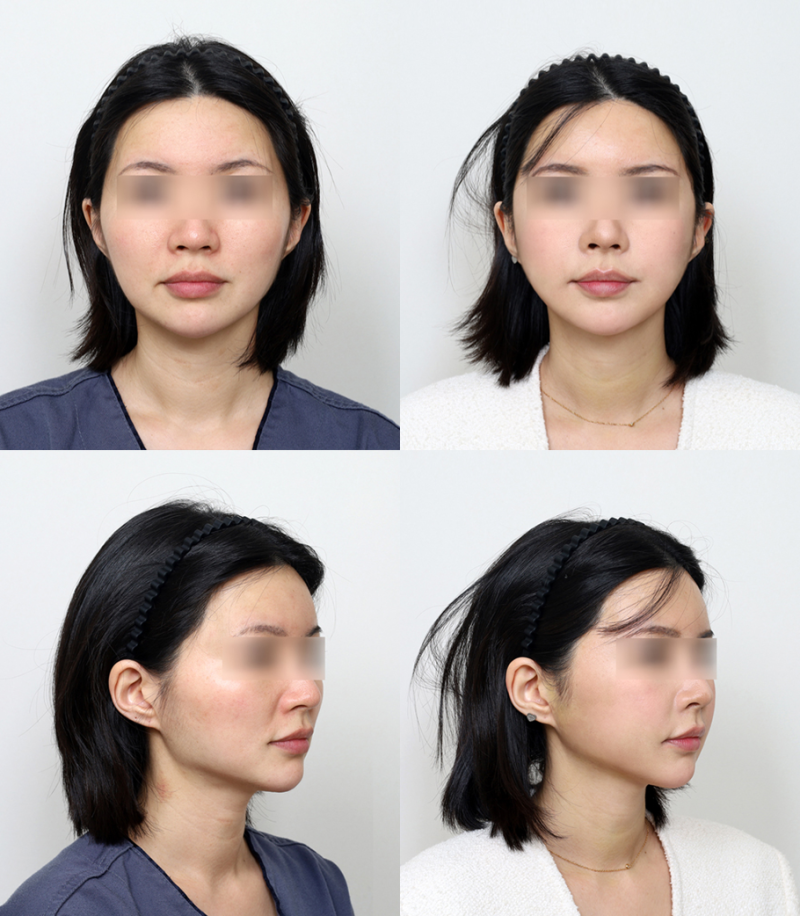
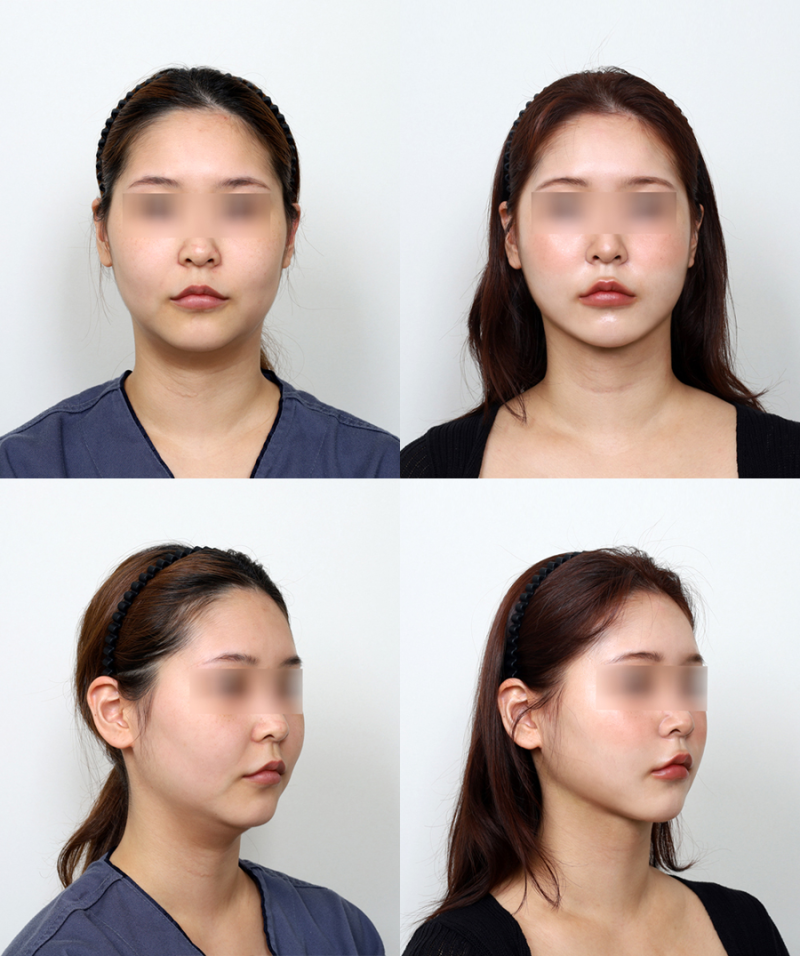
Many people worry that square jaw surgery will cause sagging.
Ultimately, a good square jaw surgery is not one that removes a lot of jawbone.
It should be a procedure that comprehensively evaluates the patient's facial shape, bone structure, and soft tissue, reduces what needs to be reduced, and preserves a natural jawline.
What matters more than making the face smaller is creating a natural contour that suits the smaller face.
I hope this information has been helpful.
Thank you.
Frequently Asked Questions
Will my face definitely sag after square jaw surgery?
No, not necessarily. Sagging appears when soft tissues such as skin and fat shift downward or lose elasticity, and it is an oversimplification to assume that the flesh will simply drop just because the lower jawbone was reduced. However, results can vary depending on the extent and method of surgery, skin elasticity, and the amount of fat and muscle.
Does the masseter muscle volume decrease after square jaw surgery?
Yes. A study published in 2022 found that in 29 square jaw surgery patients, the masseter muscle volume decreased by an average of 18.4% after surgery. However, this only shows that muscle and soft tissue can change. A decrease in masseter volume does not necessarily mean that the face sags.
Do I need to remove a lot of the mandibular angle in square jaw surgery?
No, removing a large amount does not necessarily lead to a good result. The article explains that it's important to leave a mandibular angle that suits the facial shape and to create a natural curve that flows from the chin tip to the area below the ear.
Does a thick neck make the jawline look blurry?
Yes. If the neck is thick or there's a lot of fat under the chin, the boundary between the jaw and neck may be unclear, making the jawline look short and dull. The jawline isn't determined by the jawbone alone. Subcutaneous fat under the chin, deeper fat layers, and skin elasticity also influence it.
Does removing too much jawbone make the jawline blurry?
Yes. Removing too much jawbone can weaken the original angle of the jaw and facial contour, so the jawline may look blurry instead. Making the face look smaller and making the jawline look defined are not necessarily the same thing.