2026-11-20
[Ipche Plastic Surgery] Facelift Before and After in a Woman in Her 50s: Face Lifting and Incision Scar Progress
Case study of a woman in her 50s who had a facelift, neck lift, and platysma banding after earlier lifting, with 6-week results and ear scar healing.
Hello, this is Ipche Plastic Surgery.
If you have already undergone lifting procedures but still find yourself bothered by nasolabial folds, marionette lines, and sagging under the chin, you may be considering a facelift.
This time, we've put together the case of a woman in her 50s who visited with the same concerns, covering her facelift along with neck lift and platysma muscle banding for the double chin.
About three years ago, this patient had a forehead lift and thread lifting at another clinic.
The concerns she raised this time were nasolabial folds, marionette lines, a double chin, and overall sagging of the face.
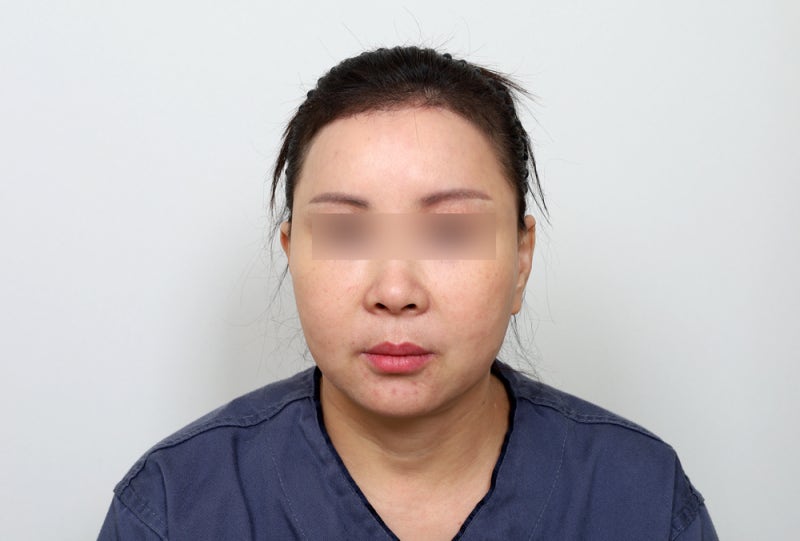
Front view of the patient in her 50s before facelift surgery, with her eyes blurred for privacy.
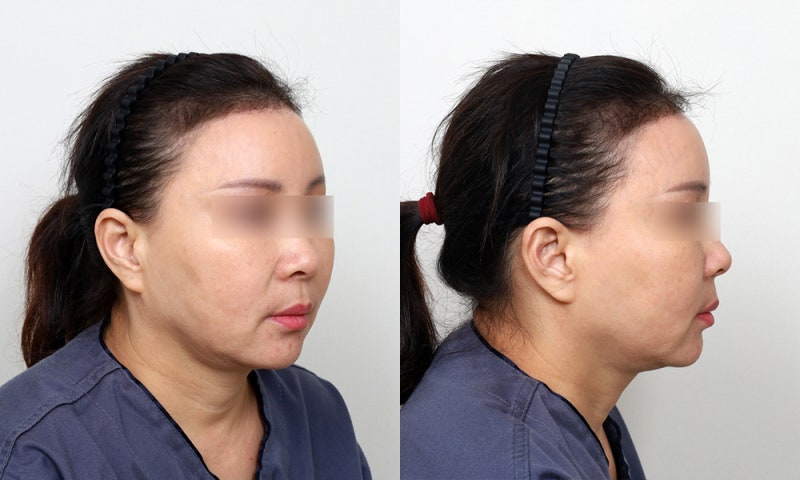
The same patient before surgery, seen from a 45-degree angle (left) and in side profile (right).
Looking at the pre-surgery photos, this patient has a relatively good amount of facial fat. As the cheek fat has sagged, the hollowing at the cheeks and the nasolabial folds stand out, and drooping at the corners of the mouth is also visible.
In addition, the loose skin under the jawline disrupts the line running from below the ear to the tip of the chin.
From the side, fat under the chin extends down into the neck, so the angle between the face and neck is barely visible.
To address overall sagging from the face down through the chin and neck, she underwent a facelift, neck lift, and platysma muscle banding together.
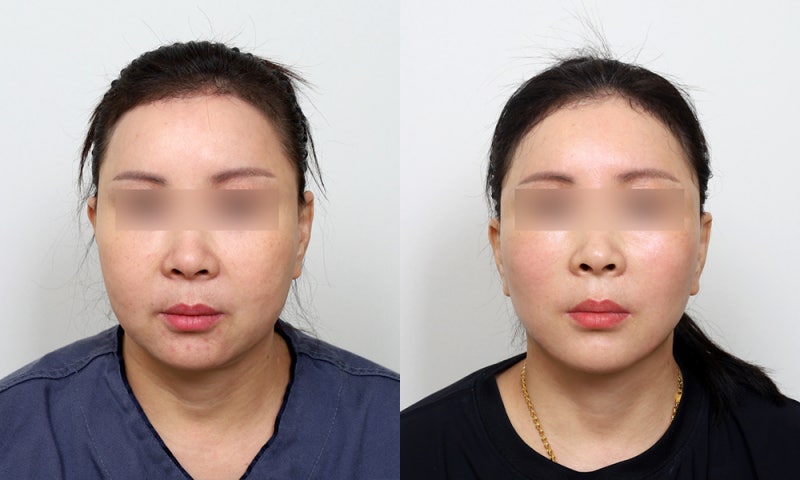
Front-view comparison before (left) and after (right) the facelift.
Let's compare the frontal views before surgery and at 6 weeks side by side.
The lower face, which had looked wide on both sides, now appears more defined, and the skin that had sagged beside the mouth has been lifted, making the nasolabial folds noticeably softer.
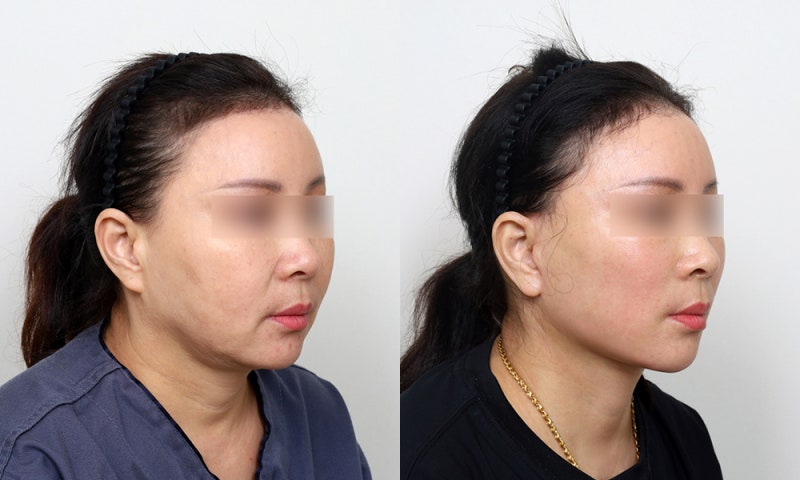
45-degree angle comparison before (left) and after (right) the facelift.
In the three-quarter view, the jawline that had looked uneven and broken now runs naturally in a single line up to the area below the ear.
Sagging under the chin has also improved, giving the facial contour a sharper, more defined look.
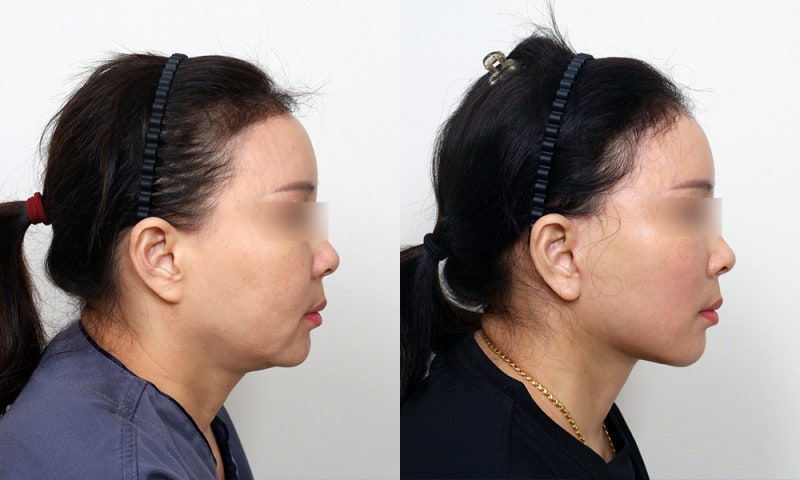
Side-profile comparison of the jawline and neck before (left) and after (right) the facelift.
In the profile view, you can compare the angle where the chin transitions into the neck.
With the platysma muscle banding and neck lift performed together, the boundary between the chin and neck has become more defined.
At 6 weeks, swelling still remains. Full resolution of residual swelling usually takes about 3 to 6 months.
Changes in ear incision scars after facelift and neck lift
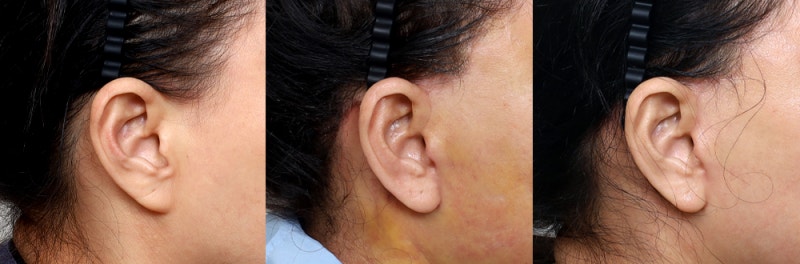
Close-ups of the area around the ear in three stages: before surgery, early recovery with yellowish bruising, and later healing.
From left to right, these show the hairline and ear incision scars before surgery, 10 days after surgery, and 6 weeks after surgery.
At 10 days, yellowish bruising remains on the face, but by 6 weeks the bruising has faded and the incision lines are much less noticeable.
How quickly and how much scars fade varies from person to person depending on skin condition, but they usually become nearly invisible after a recovery period of about one to three months.
To help you better understand this, we've attached a column on incision-line scars below.
Even after receiving lifting treatments, concerns can resurface over time as the skin, fat, and muscle layers sag together.
In such cases, it's important to carefully assess factors such as prior procedures and how far the sagging has progressed before determining the scope of the facelift.
At Ipche Plastic Surgery, we plan the combination of procedures after fully considering prior treatment history, skin elasticity, and the degree of sagging.
If, as in today's case, sagging has returned after lifting treatments, we recommend first checking during a consultation whether a facelift is needed now and what the best way to improve it would be. Thank you.
Frequently Asked Questions
Can facial sagging come back after lifting treatments?
Yes. Even after lifting treatments, the skin, fat, and muscle layers can sag together over time and the concerns can return. For this reason, it's important to review prior treatments and the degree of sagging before deciding the scope of a facelift.
When does swelling go down after a facelift?
Full resolution of residual swelling usually takes about 3 to 6 months. The 6-week mark in this case was a time when swelling still remained.
When do incision scars near the ears become hard to see?
Usually, after a recovery period of about one to three months, they become nearly invisible. However, we emphasize that how quickly and how much scars fade varies from person to person depending on skin condition.
Can a facelift and neck lift be done together?
Yes. In the case described in this article, a facelift, neck lift, and platysma muscle banding were performed together to improve overall sagging from the face down through the chin and neck. We emphasize that the combination of procedures is planned after considering prior treatment history, skin elasticity, and the degree of sagging.
What changes were seen at 6 weeks after surgery?
In this case, at 6 weeks the lower face looked more defined, the nasolabial folds were noticeably softer, and the jawline ran naturally in one line up to the area below the ear. Sagging under the chin also improved, but we emphasize that swelling still remains at this stage.